
What Demonstrated EV Adoption Indicates for the Future of Investment in EV Charging
In advising investors on opportunities in EV charging, most conversations still start with speculation as to whether governments can "hold the line" on their EV-related policies. However, a quick look at the data indicates the effectiveness with which EU and UK policy is already driving us beyond an irreversible inflection point to faster and more predictable growth in:
- Sales of battery electric cars & vans (BEV),
- The penetration of BEV within our national vehicle fleets and
- The demand of those BEV drivers for energy from the public charging network.
Market Evidence
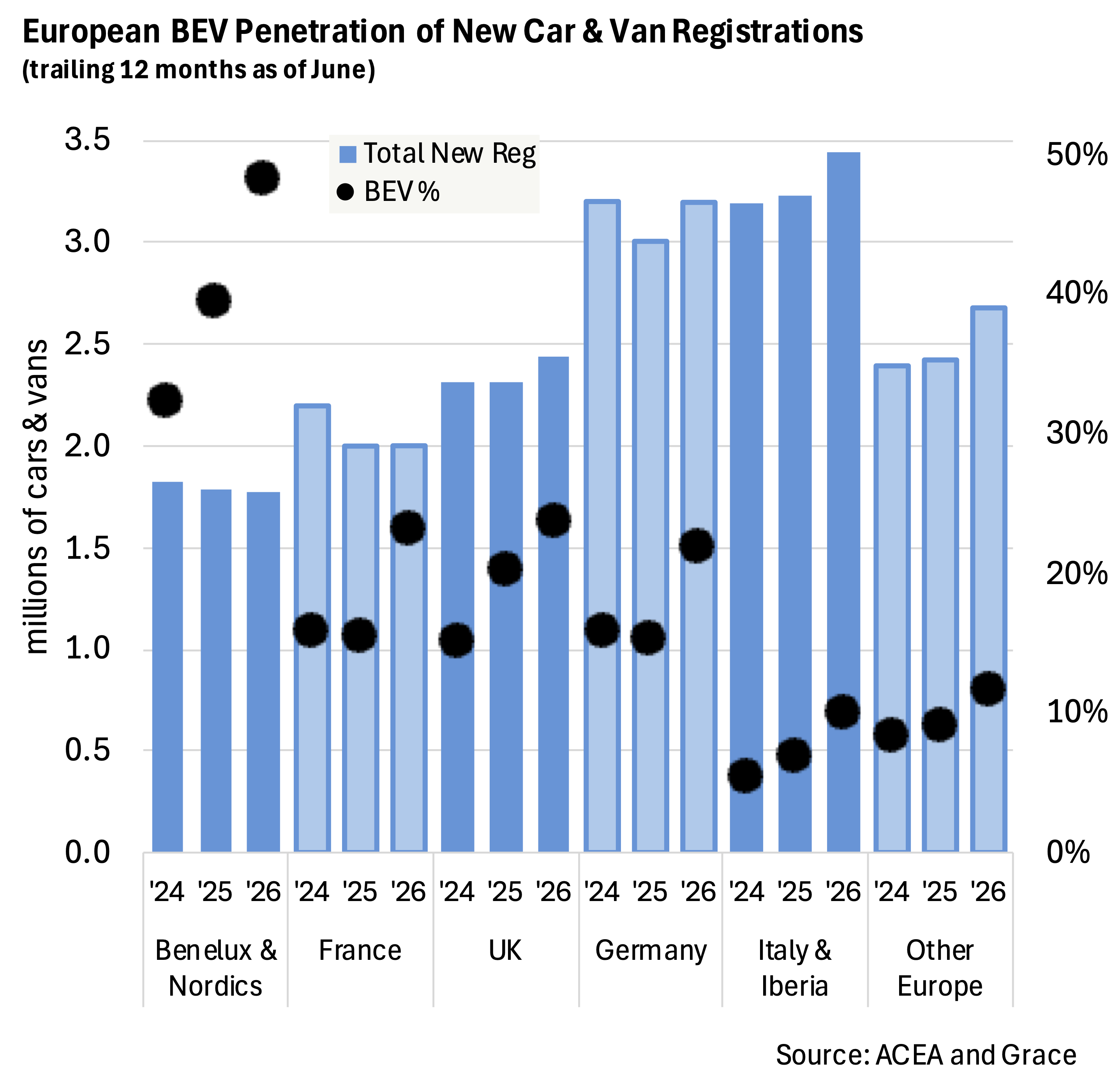
Through the 4 successive 12-month periods ending in June of this year, data from the European Automobile Manufacturers' Association (ACEA) indicates a significant uptick in BEV uptake that directly relates to implementation of the UK's ZEV Mandate for 2024 and the EU's CAFE regulation one year thereafter.
Focus on UK Policy and Mandated Predictable Growth
Here in the UK, while representative bodies like the Society of Motor Manufacturers and Traders (SMMT) continue to lobby for delays in policy implementation, anecdotal evidence indicates both government commitment and market inevitability:
Government Commitment - In response to its 2025 public consultation on implementation of the ZEV Mandate, Government progressively adopted certain "flexibilities" that accomodate manufacturer compliance while preserving policy objectives. There is very little reason to believe that government response to the 2nd consultation, which is scheduled within the Mandate itself for later this year, will result in a radical alteration of terms.
Market Inevitability - At 11% share, the UK is an integral part of the pan-European vehicle market, which vies with North America for second place after global behemoth China. Though implemented somewhat differently, UK and EU policies both mandate accelerating BEV uptake to a total ban on non-ZEV saldes by 2035. Because manufacturers must plan their production to retain access to the regulated market, unilateral UK action to delay the its Mandate would have little impact on supply of non-ZEV vehicles.
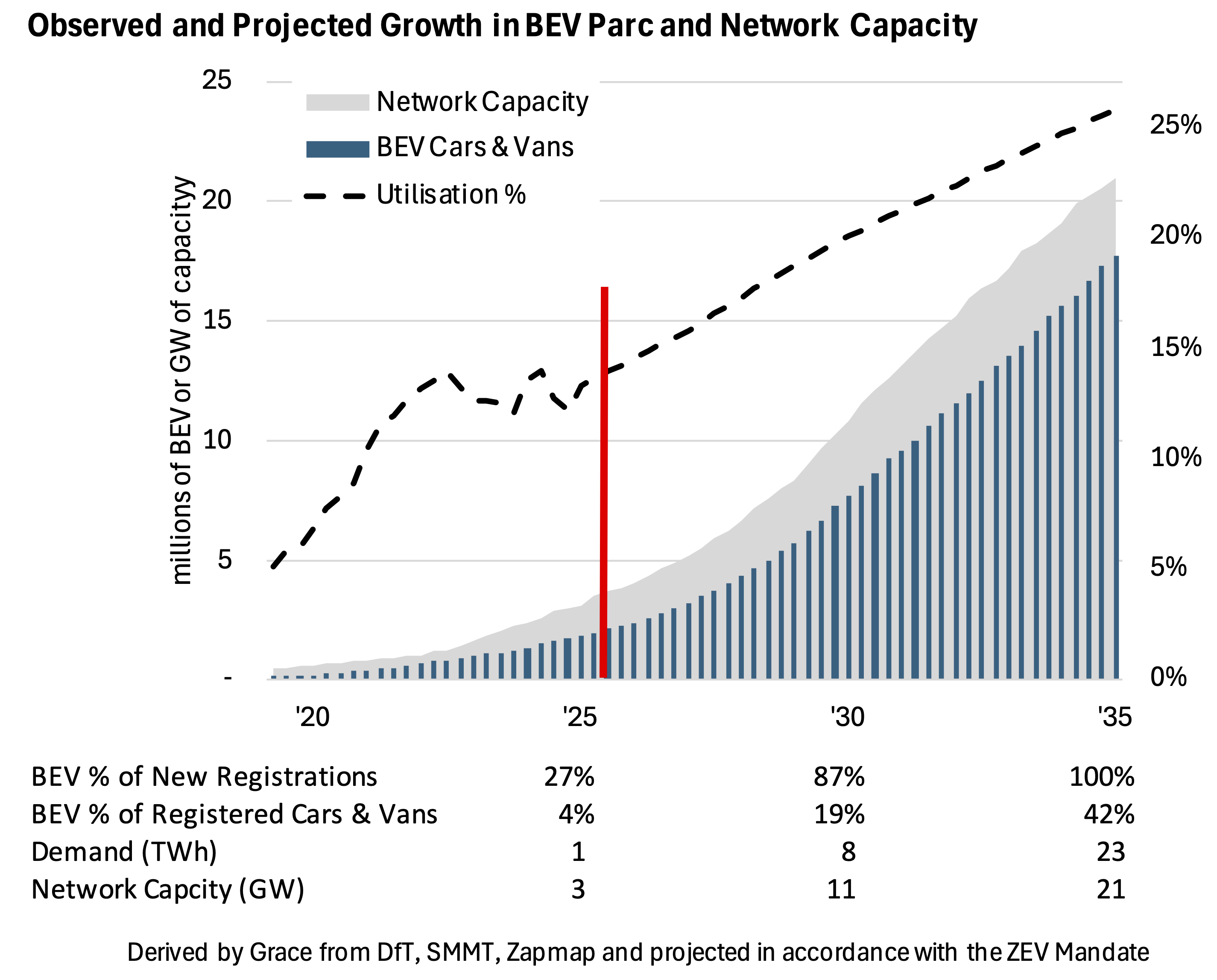
Comprised largely of consumer incentives and supplier quotas in an accelerating "trajectory", the UK's ZEV Mandate is pushing us beyond an inflection point towards BEV penetration of all registered cars on UK roads to nearly 20% by 2030 and over 40% by 2035.
Conclusion
These observations drive a compelling logic trail:
- Appetite for investment opportunities in the public EV charging network reflects investors perspective on cash flows to be derived from serving an expanding corps of EV drivers.
- Growth in energy demand of those drivers from the public charging network is a function of government mandated growth in BEV penetration of new car & van sales.
- Given the demonstrated effectiveness of both government policy and of government's maintenance of their policy, projection of demand isn't speculation as to the vagaries of consumer appetite. Rather, it's a mathematical extrapolation of government policy that has so far proven "effective".
Not only is the die cast on our EV transition, but government mandate indicates the value of each throw of that die.