
A Clearer Perspective on BEV Uptake
BEV penetration of new car registrations grew to 28% in June 2026, further validating the efficacy of UK policy and comparable EU policies in predictably driving BEV uptake across the continent. However, increasingly higher hurdle rates in the ZEV Mandate place increasingly greater pressure on manufacturers preserving their access to the UK market.
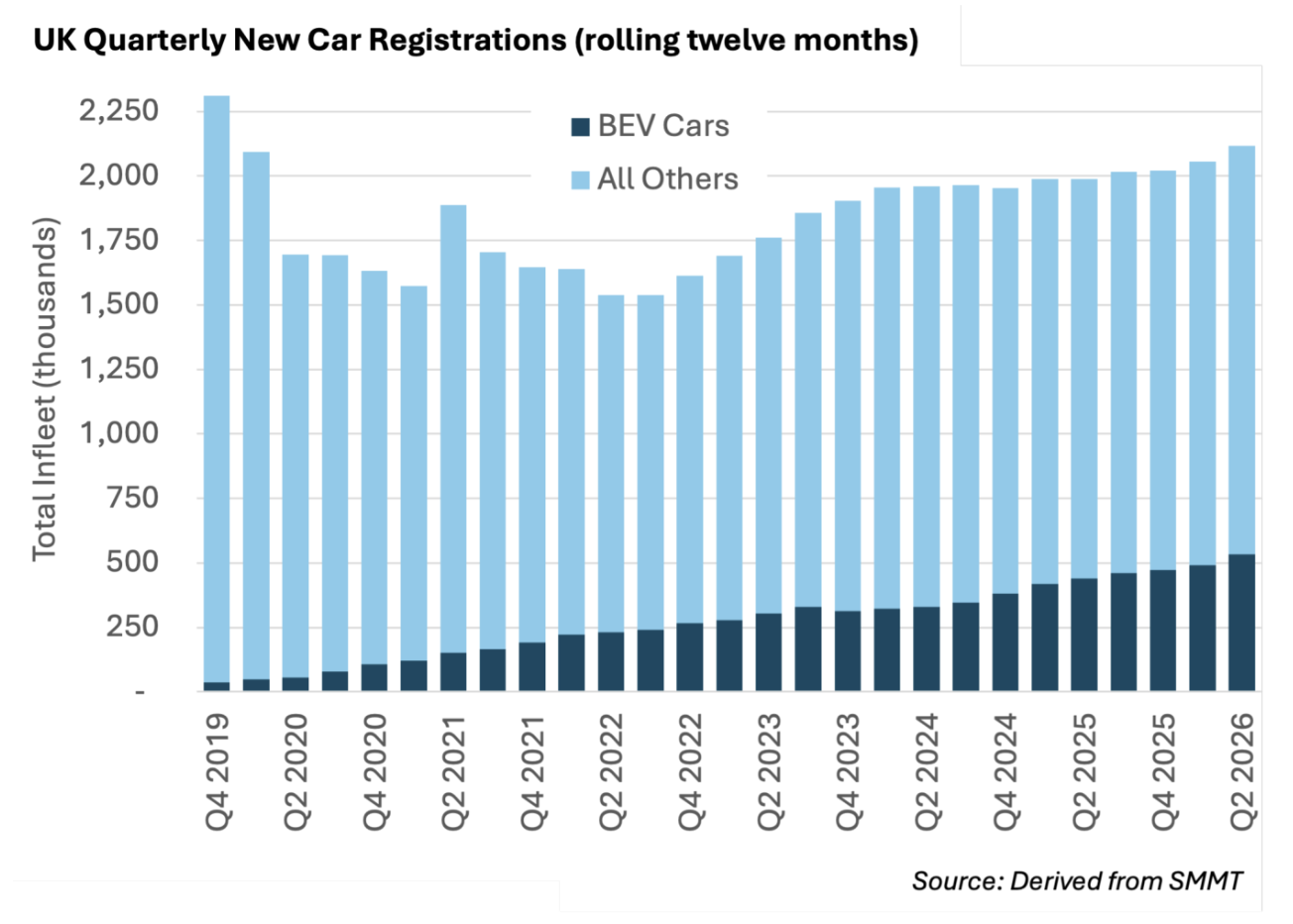
In looking at the chart below, a couple of observations jump off the page:
Persistent growth in the number of new cars registered since the Summer of 2022 indicates that drivers continue to reverse the "stretching" of their vehicles' useful lives that resulted from a post pandemic scarcity in new car availability.
Burdened by UK regulation, manufacturers have consistently increased the penetration of BEV within their new car sales to roughly 30% last month and 25% through the first half of 2026.
A Closer Look at the Numbers
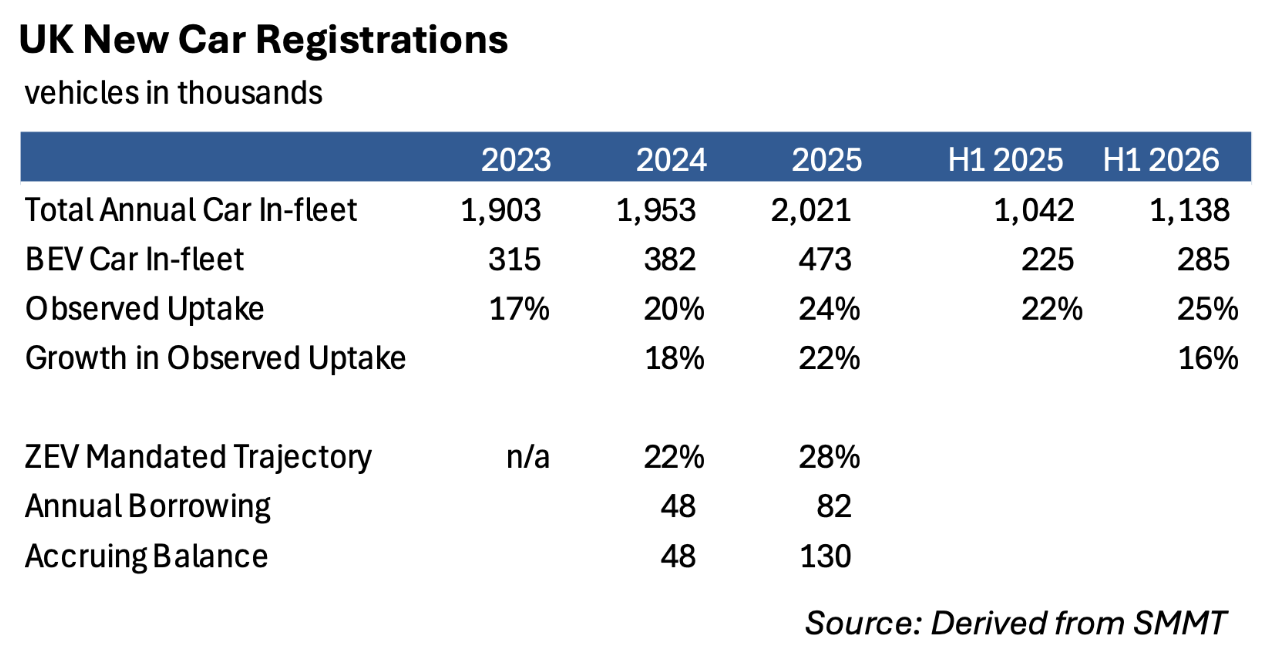
Again, a few observations jump off of the table below:
By 2025, observed uptake of new BEV cars has increased over 40% to 24% since the 2023, the year prior to inception of the ZEV Mandate.
While observed uptake of 20% and 24% fell just short of the Mandated trajectories of 22% and 28% in 2024 and 2025, "flexibilities" accommodated in the Mandate compel a full repayment of these 130,000 "borrowed" BEV sales by 2030 (with very little impact on the pace by which BEV penetrate the UK's parc of registered cars).
The first half of 2026 continues to demonstrate predictably growing penetration of BEV. Representing 25% of all new car registrations, H1 penetration is up 16% over prior year.
Increasingly Higher Hurdles
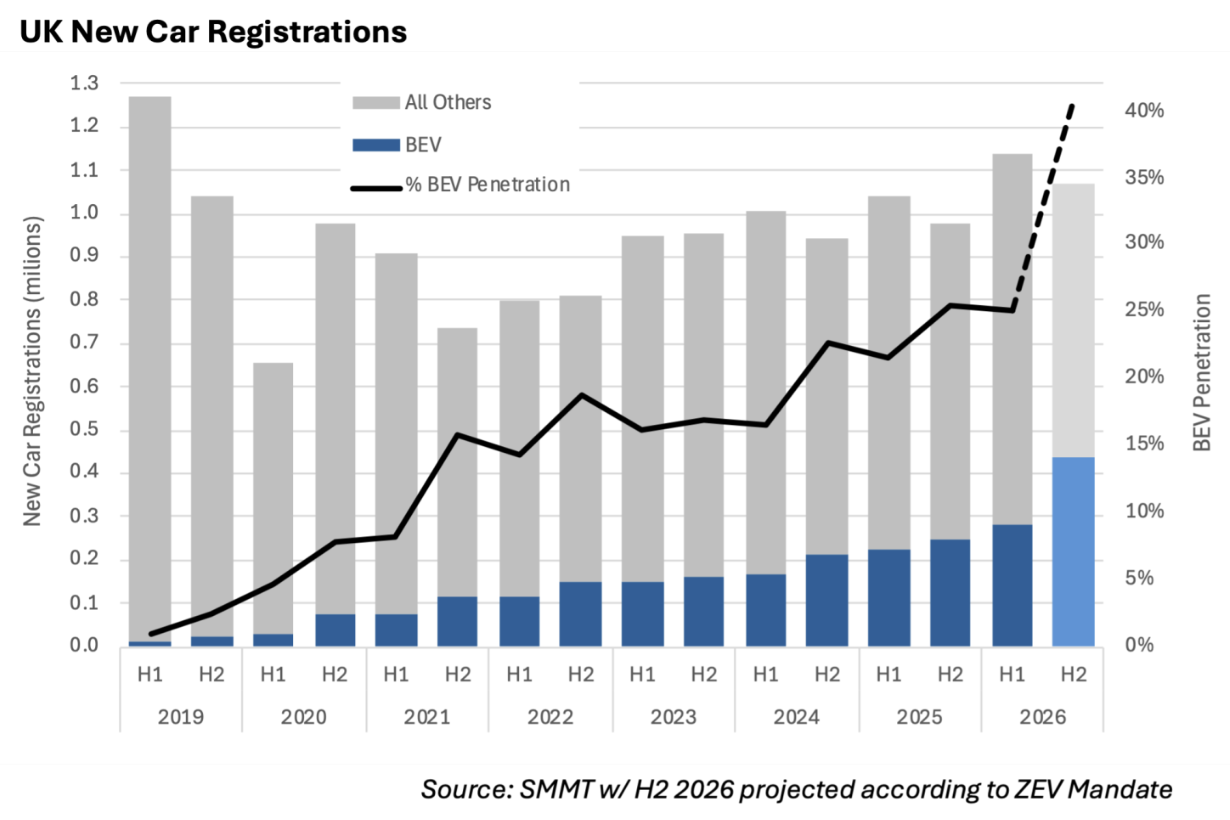
From the 28% Mandated trajectory last year (against which manufacturers achieved 24%), the 2026 target rises all the way to 33%. Again, some observations jump off the chart:
- The over 1.1 million new cars registered in H1 2026 is the largest total since H1 2019 and represents 9% YOY growth.
- The 285 thousand BEV registered in H1 2026 was a record high, but actually reflects lower penetration than the previous 6 months as a function of the higher total new registration figure.
- From that 25% penetration through the first half of 2026, new BEV registrations through the next 6 months will have to approach 450 thousand (penetration of about 40%) to reach the full-year Mandated target of 33%.
Conclusion
None of this is new. The headline of the ZEV Mandate has always been a limitation on sales of non-zero emitting vehicles to a total ban by 2035. However, en route to that ban, this 33% target for 2026 will be tough. From less than 50 thousand BEV through the first six months, average monthly BEV sales will need to hover around 75 thousand through the end of the year.
Of course, this isn't yet "do or die" for auto manufacturers striving to maintain their access to the UK and European markets. Mandated flexibilities still accommodate a limited amount of shortfall in BEV sales through 2030 and because related borrowing of non-ZEV allowances must be fully repaid by 2030, these shortfalls don't have a massive impact on the rate by which BEV counts continue to grow within the parc of registered cars on UK roads.
While the UK and EU have proven so far to be very effective in driving new BEV registrations, there will continue to be friction with manufacturers, financiers and drivers as the hurdlies become increasingly more challenging.